March 2026
Highlights
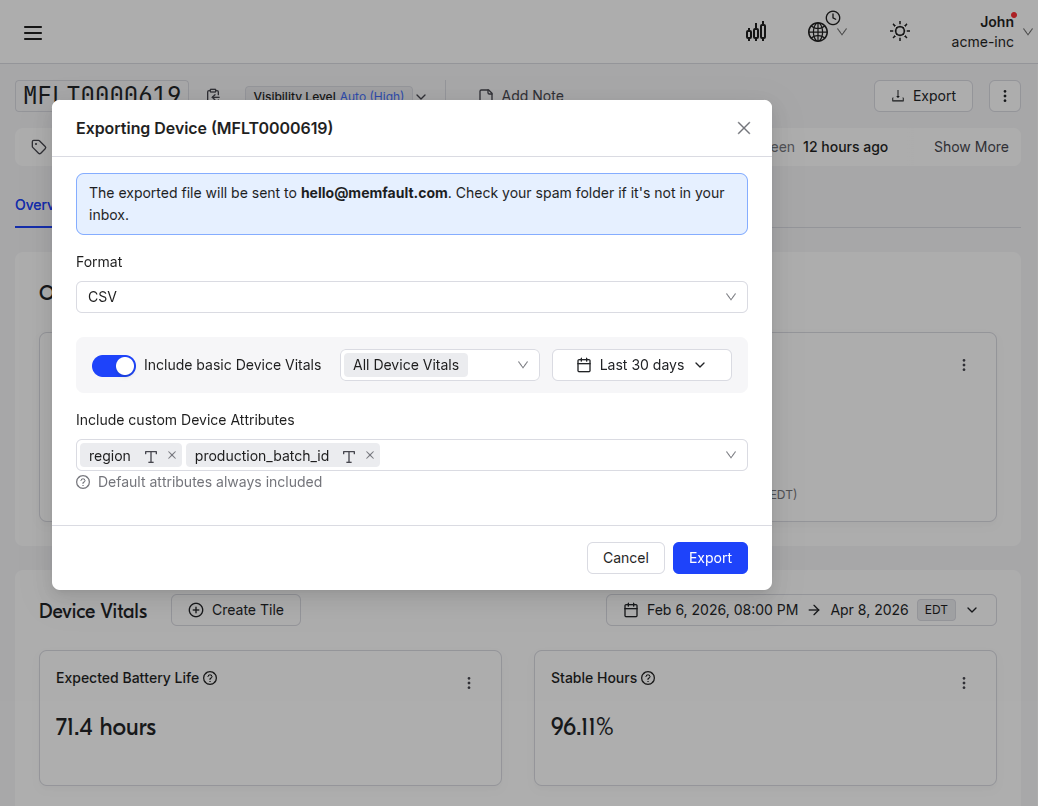
Export Device Vitals
Device Vitals columns are now included in device CSV exports.
You can also export data directly from a single device's detail page, making it easier to pull a single device's history for offline analysis or sharing with hardware teams.
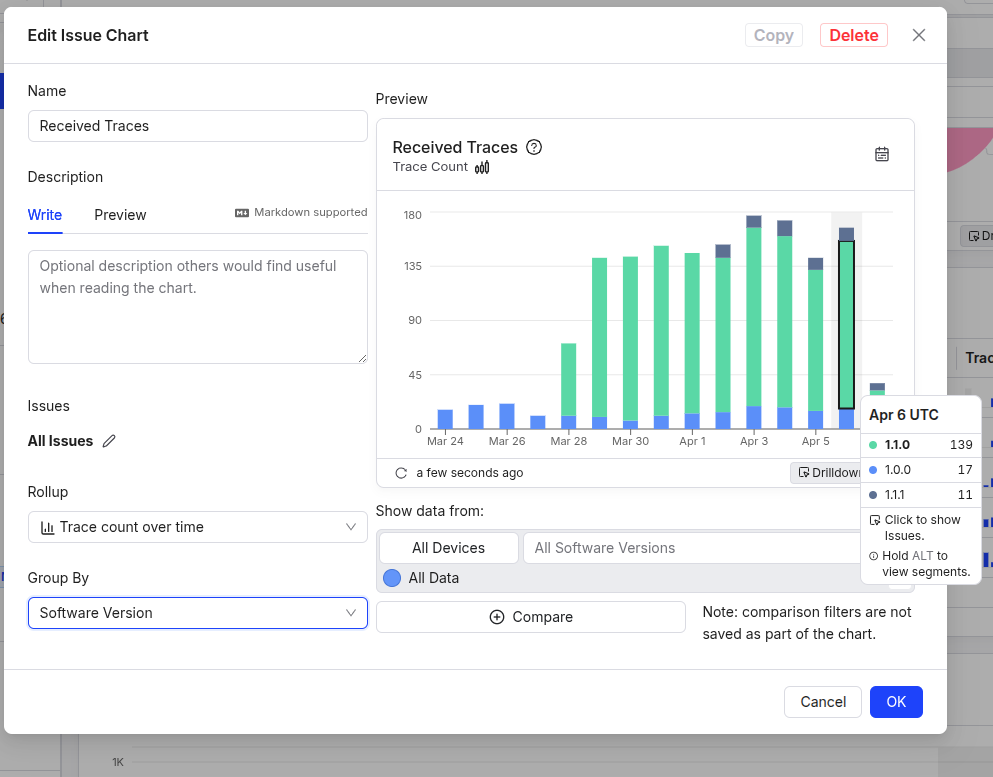
Trace Count Grouped by Software Version
Issue Chart: Trace Count Over Time cards now support a "Software Version" group-by option, letting you see trace volume broken down by the versions of software running across your fleet. This makes it easy to confirm whether a bug affects a specific release or spans multiple versions.
General
- Device Vitals columns are now included in CSV device exports, and a single device's data can be exported directly from the Device Detail page.
- Issue Chart cards now support grouping by Software Version, making it easy to see trace distribution across releases.
- The Upload Traces modal now correctly detects and handles MAR files in addition to ZIPs.
- For nRF Cloud customers, account registration, user invites, and team permissions are now managed in app.memfault.com.
Device SDK Updates
MCU: [1.37.1] - 2026-03-24, [1.37.0] - 2026-03-23, and [1.36.0] - 2026-03-11
See the full MCU SDK changelog.
- Added a Memfault MCUmgr command group for Zephyr, enabling FOTA via MCUmgr (SMP over BLE) without a secondary interface
- Improved nRF Cloud CoAP: data now uploads directly to the
/chunksendpoint without requiringCONFIG_MEMFAULT_HTTP_ENABLE, and supports automatic project routing via Project Key - Refactored Zephyr HTTP client to use native
zsock_socket functions, removing the POSIX API compatibility layer requirement - Added optional watchdog interrupt return behavior via
MEMFAULT_FAULT_HANDLER_WATCHDOG_RETURN, and ESP-IDF v6 compatibility
Android: [v5.8.0] - 2026-03-26 and [v5.7.0] - 2026-03-10
See the full Android SDK changelog.
- Added support for Android 16
- Added
uptimeandboot_idto metrics and reports, with optional uptime-based timestamp adjustment for more accurate metric aggregation across reboots - Added Bluetooth disconnect metrics (
bluetooth.disconnect,bluetooth.disconnect_reason,bluetooth.disconnects) collected via statsd - Fixed battery metrics over-writing on unchanged values (reducing up to ~500 MB/day of unnecessary storage) and fixed diskstats bytes-written being over-reported by 8×
Linux
[1.26.1] - 2026-03-26 and [1.26.0] - 2026-03-06
See the full Linux SDK changelog.
- Added automatic sysfs battery metrics when a battery node is present, plus a
new
battery_soh_pctState of Health metric, with no extra configuration needed - Log filter configuration can now be pushed from the server via device config, allowing log verbosity to be adjusted remotely without changing on-device settings
- Added min/max tracking option for individual metric keys alongside averages
- Fixed a crash in journald log collection when encountering empty or malformed cursor files
SDK: [1.8.0] - 2026-03-06
See the full CLI changelog.
-
Add the
--org-tokenoption for authenticating with an Organization Auth Token (OAT). This is now the recommended way to pass OATs to the CLI. Previously, the documented approach was to pass the OAT via--password:memfault --password "$ORGANIZATION_AUTH_TOKEN" ...This should now be updated to use
--org-token:memfault --org-token "$ORGANIZATION_AUTH_TOKEN" ...Passing an OAT via
--passwordis deprecated and will be removed in a future release. -
Update
virtualenvdependency to>=20.36.1to address this security disclosure.